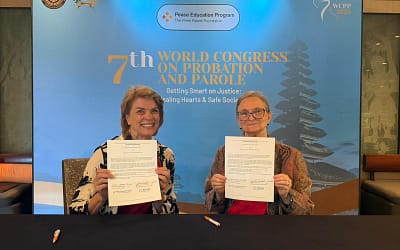
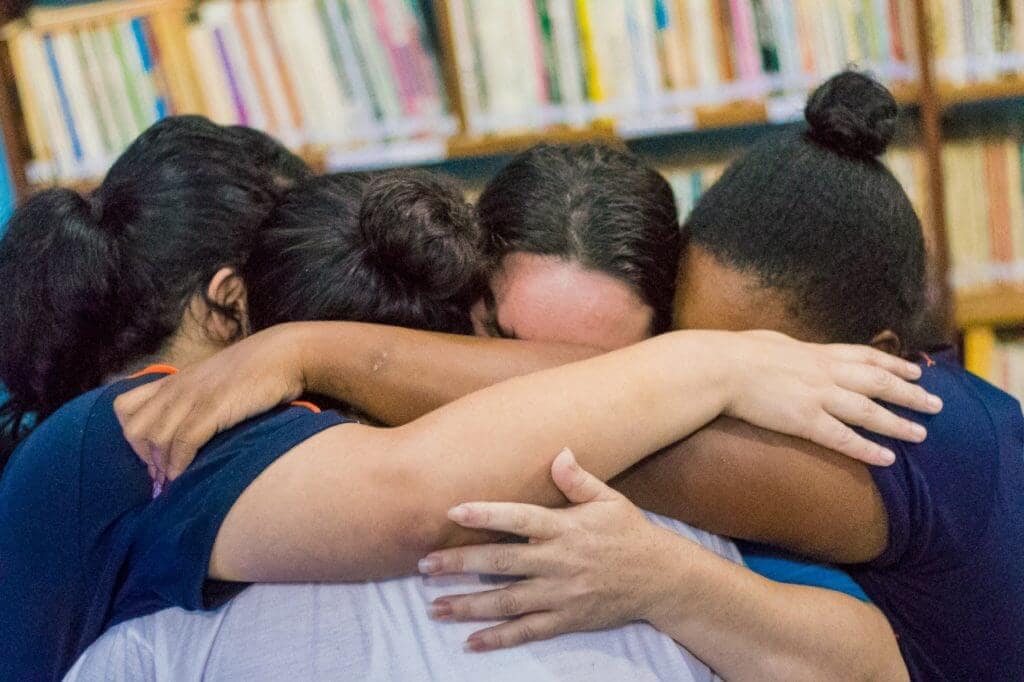
Across the world, the Peace Education Program by The Prem Rawat Foundation (TPRF) has been implemented within correctional settings as part of institutions’ broader psychosocial support and rehabilitation efforts. As of December 2025, more than 200,000 people in the corrections sector, including staff and clients, have participated in the program across the globe, with some reporting a wide variety of benefits.
A recurring theme for many corrections professionals is whether the Peace Education Program can support clients’ reintegration and rehabilitation after their release. In Brazil, a state agency recently reported lower recidivism rates among people who participated in the Peace Education Program, meaning fewer participants returned to the prison system after their release.
This Brazilian state-run organization, the State System of Methods for Sentencing and Social Adaptation of Recovering Inmates (SEMEAR), implemented the Peace Education Program alongside hundreds of other psychosocial initiatives across 159 prisons. According to SEMEAR, out of the 2,291 inmates who completed the Peace Education Program, 2,010 (87.7%) did not reoffend after their release. This rate exceeds Brazil’s national non-recidivism average rate of 57.5%.
You can download a PDF of the letter from SEMEAR here, or read it below:

Dear Members of The Prem Rawat Foundation,
The State System of Methods for Sentencing and Social Adaptation of Recovering Inmates (SEMEAR) was established by the General Inspectorate of the Court of Justice of the State of São Paulo through Provision CGJ No. 30/2014, in partnership with the Secretariat of Penitentiary Administration and the Instituto Ação pela Paz.
The program is designed to contribute to the rehabilitation of incarcerated individuals, former inmates, and their families. Inspired by the methodologies of APAC (Association for the Protection and Assistanceof Convicts) and the Rehabilitation Centers of the State of São Paulo, SEMEAR integrates civil society engagement, volunteer activities, and inmate participation in the fulfillment of their sentences.
The program’s initiatives encompass areas such as employment, education, health, legal and psychosocial assistance, in accordance with Brazil’s Sentencing Enforcement Law (Law No. 7,210/1984). In addition, SEMEAR promotes emotional support for inmates and provides training for prison staff.
The governance model includes participation from prison unit managers, local judges, and organized civil society. A key mechanism for collaborative action is the Community Councils of the Criminal Enforcement Court (CCVECs), where prison units share their needs with the CCVEC and the presiding district judge. Depending on stakeholder coordination, these needs are addressed with support from municipalities, state agencies, the judiciary, universities, private companies, volunteers, and local organizations.
To evaluate the program’s impact, five criminal recidivism assessments have been conducted. Among 10,627 participants evaluated, 84.49% (8,979 individuals) had not reoffended or returned to the prison system for a new crime as of April 2024. This significantly exceeds the national average of 57.5%, as reported in the most recent survey conducted by Brazil’s National Council of Justice (CNJ) in 2020.
Between 2014 and July 2024, SEMEAR received R$7,245,475.19 in private investment directed exclusively toward projects. These resources supported 775 initiatives across 159 prison units, reaching 87% of the state’s correctional system. In total, 30,188 incarcerated individuals and 5,697 former inmates were served.
The psychosocial projects recorded an average non-recidivism rate of 87%. Among the 2,291 inmates who completed the Peace Education Program, based on the methodology developed by The Prem Rawat Foundation (TPRF), 2,010 (87.7%) did not reoffend after their release.
In an evaluation conducted in June 2021, a participant shared the following reflection:
“We live with two sides within us—50% good, 50% bad—and they are in constant conflict. Each wants to dominate. The one we feed more will prevail. That’s why it’s so important to take advantage of all the activities offered here.”
This analysis considered 5,101 students who participated in classes between 2019 and 2022. Of that total, 2,274 remained incarcerated, and 528 could not be evaluated due to inconsistencies in their records.
All activities related to the Peace Education Program are overseen by Ivete Belfort, who is directly responsible for the methodology’s implementation in Brazil and certifies, on behalf of TPRF, the accuracy of the reported data.
Looking ahead, SEMEAR has outlined a strategic set of goals aimed at enhancing and expanding its impact:
1. Conducting monthly meetings with key program stakeholders;
2. Increasing project implementation across all regional prison coordination units in São Paulo;
3. Integrating the issue of drug dependency, addressed from diverse perspectives and contexts;
4. Improving the measurement and analysis of criminal recidivism data, including documentation of the various types of support offered to inmates and former inmates;
5. Expanding and strengthening the Community Councils of the Criminal Enforcement Court (CCVECs);
6. Enhancing institutional communication among SEMEAR, the Secretariat of Penitentiary Administration, the Court of Justice, and civil society;
7. Including SEMEAR content in training programs at the São Paulo School of Magistracy;
8. Reviewing current partnerships and identifying new strategic stakeholders for the signing of cooperation agreements and addenda.
The Court of Justice of São Paulo, the State Secretariat of Penitentiary Administration, and the Instituto Ação pela Paz continue to monitor the program’s data and remain fully available to present results and explore avenues for collaboration.
Warm regards,
Solange Rosalem Senese
Executive Director and Co-Founder
Instituto Ação Pela Paz
Official Member Organization of the SEMEAR Program