
The Peace Education Program for Schools and Universities
An Innovative Video-based Workshop Designed to Help Students:
*Develop inner resources
*Make better choices
*Become more resilient


To learn more and inquire about offering the course, email our team of educators: [email protected]
Overview
The Peace Education Program for Schools and Universities is an innovative series of video-based workshops that help students discover their own inner strengths and personal peace. Rather than describing or defining personal peace, the program encourages individuals to reach their own understanding.
The course consists of 10 workshops, each based around a particular theme, and includes 20-30 minutes of short videos. The materials are drawn from Prem Rawat’s international addresses, media interviews and interactions with a diverse range of people. The content is inclusive and non-political.
The Peace Education Program focuses on 10 themes: Peace, Appreciation, Inner Strength, Self-Awareness, Clarity, Understanding, Dignity, Choice, Hope and Contentment. After viewing the video segments, students have time to reflect on the theme and engage in activities designed to help them develop greater understanding and personal awareness.
The Peace Education Program for Schools and Universities is specifically designed for students ages 18 and older. Accompanying print material includes an Educator’s Guide and Participant Workbook. There are no tests in the Peace Education Program as the course goal is to promote individual self discovery.
The Prem Rawat Foundation (TPRF) makes the workshop series available free of charge and provides support and guidance for facilitating the workshops virtually or in person.
Social Emotional Learning Standards
While the Peace Education Program is not an SEL curriculum, it supports the educational competencies identified by The Collaborative for Academic, Social, and Emotional Learning (CASEL): Self-Awareness, Social Awareness, Responsible Decision-Making, Self-Management and Relationship Skills.

Resources for The Peace Education Program for Schools and Universities
For Students
72-page Participant Workbook
The workbook provides six pages of course materials for each of the 10 themes, covering content, conversation topics and activities that support reflection and retention.
For Educators
Downloadable Course Videos
Engaging videos explore each of the 10 themes.
114-page Educator’s Guide
The guide includes all of the content noted above, plus additional context and guidance for facilitators.
Key Understandings
A brief summary of the central ideas presented in each theme.



About The Prem Rawat Foundation (TPRF)
The Prem Rawat Foundation makes the Peace Education Program available free of charge and provides support and guidance for facilitating the workshops virtually or in person. Since 2012, the course has been presented to over 400,000 people in 80 countries and translated into 40 languages. TPRF also has several other humanitarian initiatives to provide food, water and other aid to people in need, earning the highest rankings from independent charity evaluators for transparency, financial accountability and leadership.
Sign up below for a free 45-minute webinar
What students and teachers say:
Teacher from New Zealand
Teacher from USA
Ph.D. Student from Nepal
University Student from Ukraine
University Student from New Zealand
“Now when I wake up each morning, I have the opportunity to start fresh and make the most of the day ahead.”
Download Program Materials
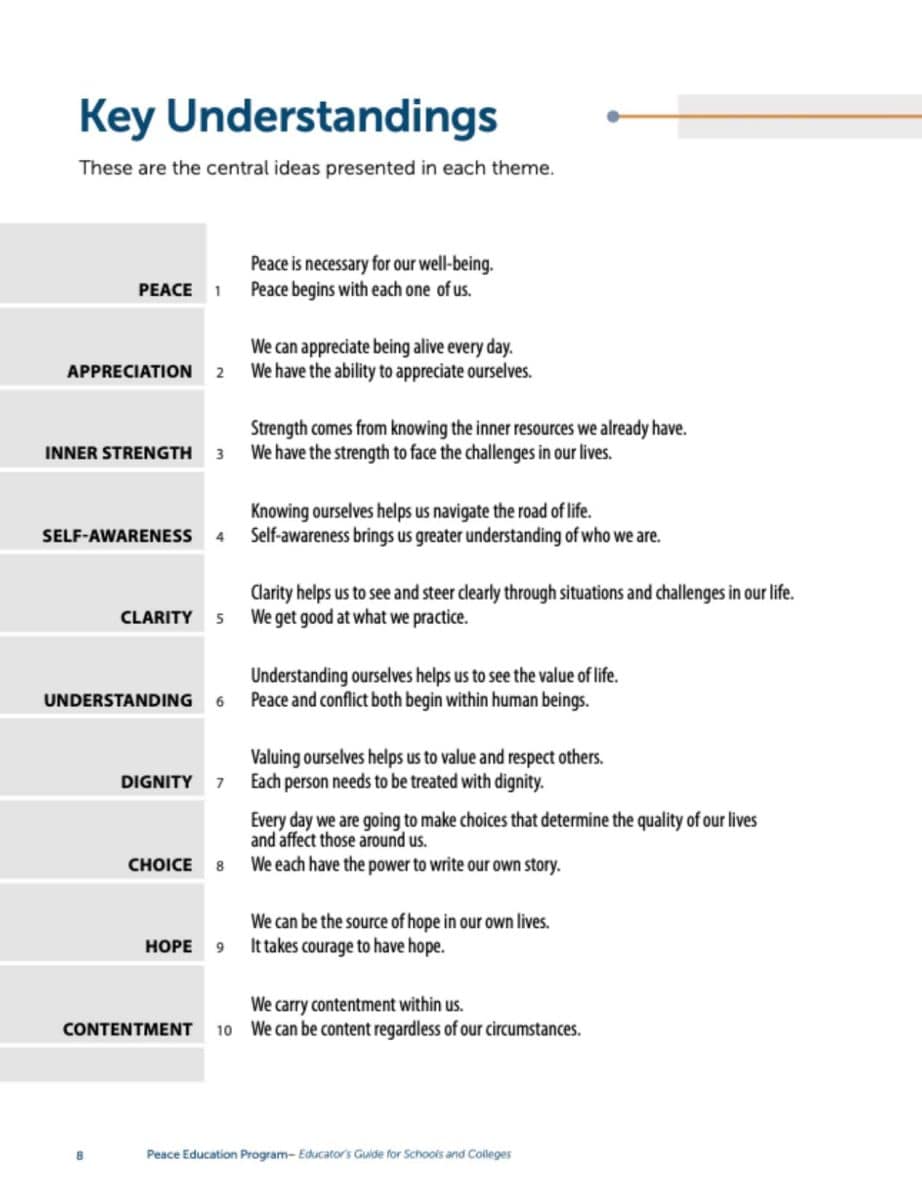
Key Understandings (PDF)
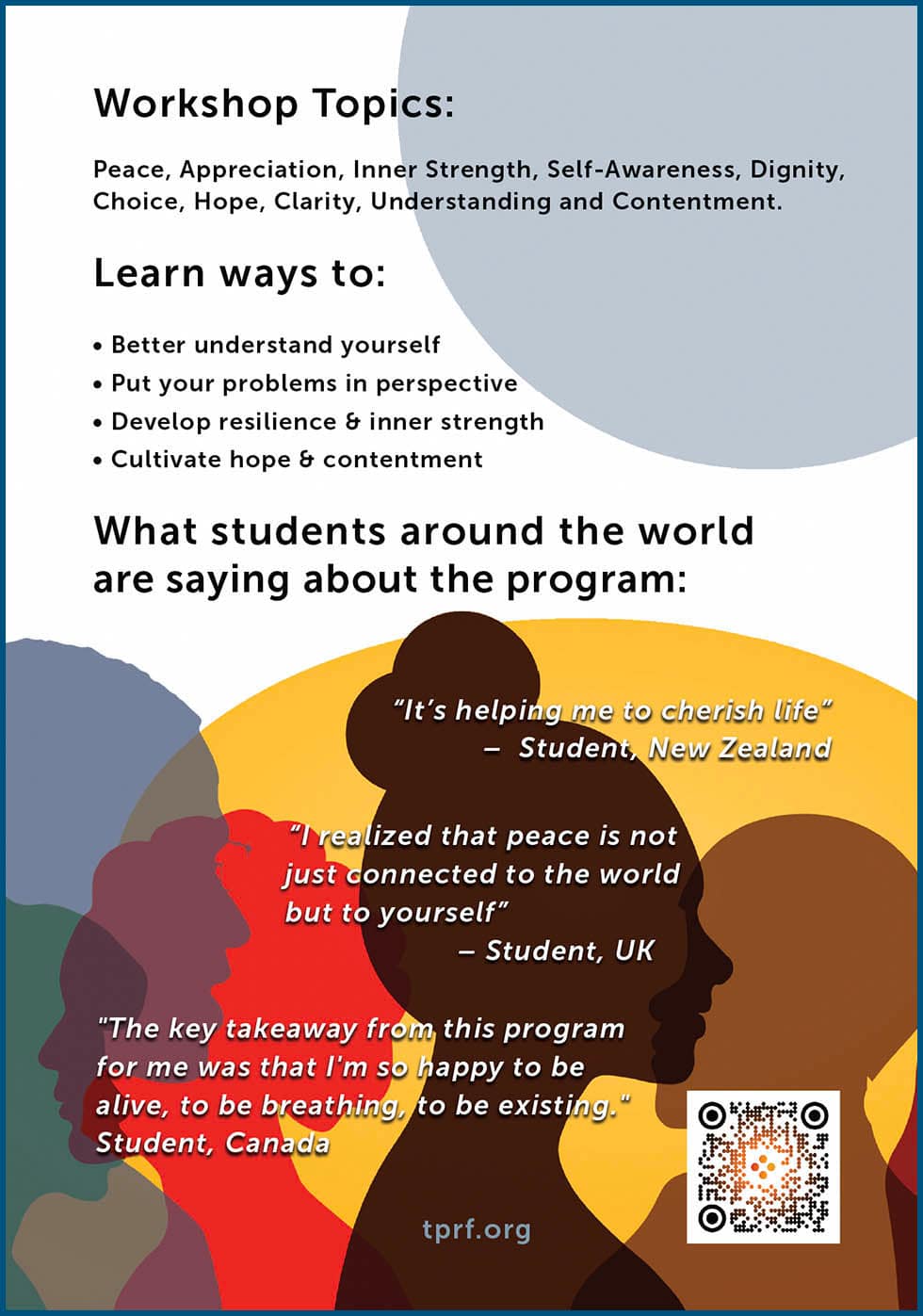
Student Flyer -Two sided (PDF) flyer designed to build student interest with QR code linking to the Student Trailer.
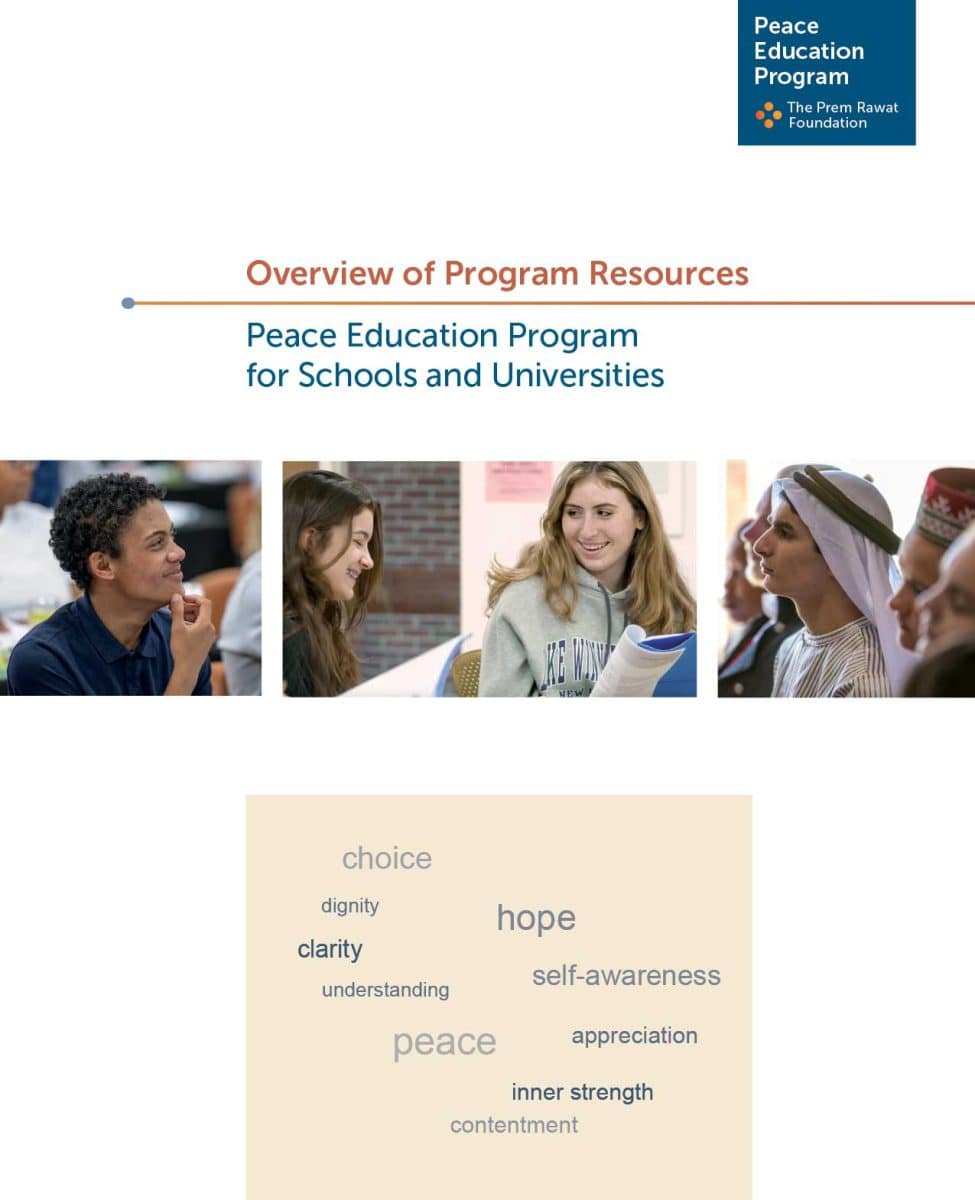
PEP EDU Overview of
Program Resources (PDF)
Peace — PDF Activity Download: Fostering Peace

Inner Strength — PDF Activity Download: Facing Challenges
Choice — PDF Activity Download: Write Your Own Story
Students at the prestigious Technical University of Denmark share how the Peace Education Program helped them put their problems in perspective and gain a sense of wellbeing.

The Secretary of Education in Atlàntico, Colombia explains why the department is implementing the Peace Education Program at high schools.

See how the Peace Education Program is benefiting students at a public school in Elbert, Colorado.

Popular at public schools in Cusco, Peru, the Peace Education Program is bringing together students, teachers, and police to cultivate new hope and understanding.
Program Studies
“Evaluation of the Peace Education Program for Schools”
Read the Summary with Key Takeways
- 100% of participating students reported that “the program helped them in their lives” and
82% said they would recommend the program to others. - Teachers reported that the program “complemented other learning activities, improved academic performance, student attitudes and self-awareness.”
“An Evaluation of the Facilitator Experience of the Peace Education Program (EDU)”
In 2023 an evaluation of the Peace Education Program EDU facilitator experience across schools in India, Australia, New Zealand, United States and England reported strong endorsements for how the program benefits students across different ages and cultures by focusing on self-reflection and universal considerations. The evaluation was produced by Tātai Angitu, Institute of Education, Massey University, Palmerston North, New Zealand.
Key Takeways
- Facilitators “endorsed the program’s ability to appeal to and engage students of different ages, in different education sectors” and the evaluation found that “the course materials offer layers of demanding complexity, nuance and depth from which students can derive personal insights and growth.”
- The evaluation found that the program materials “reach across and transcend religious, cultural and ethnic differences.”
“Impact Evaluation of the Peace Education Program
on Students of the Unihorizonte University Foundation of Bogotá, Colombia”
In 2021 the Unihorizonte University Foundation of Bogotá, Colombia completed an impact evaluation of the Peace Education Program on students, finding that the program helped nearly all of them recognize and be more aware of their internal resources as valuable tools for their lives. Attitudinal changes included enhanced appreciation for life; behavioral changes included empowerment to make changes in one’s own life, and in relating to others.
Read the Summary with Key Takeaways
• Awareness of internal resources including peace, appreciation, choice and hope, increased from 55% to 97%.
• Changes included enhanced appreciation for life; understanding the possibility and importance of feeling peace; empowerment to make changes in life.
To learn more and inquire about offering the course, email our team of educators: [email protected]
FAQs about the Peace Education Program for Schools and Universities (PEP EDU)
What is the Peace Education Program for Schools and Universities?
The Peace Education Program for Schools and Universities (PEP EDU) is designed for students ages 18 and older. Each of the 10 sessions is based around a particular theme with 20 – 30 minutes of short videos. The content is drawn from author and peace educator Prem Rawat’s international presentations, media interviews and interactions with a diverse range of audiences. The content is inclusive and non-political. The workshop sessions are designed to promote critical and creative thinking, genuine reflection and thoughtful conversation, while helping students develop greater personal awareness and resilience.
How can I bring the PEP EDU to my school or university?
Educators who are interested in bringing PEP EDU to their educational institution should send an email to [email protected]. A member of the TPRF Educator Support Team will get back to you to provide assistance.
What is involved in starting a PEP EDU course?
Visit the PEP EDU website to become familiar with information about the course and available resources, including course content, videos from the field, research and evidence.
Send an email to [email protected] to express interest in offering the course. A member of the TPRF Educator Support Team will get back to you to provide assistance.
Is PEP EDU considered to be a Social Emotional Learning (SEL) curriculum?
The Peace Education Program is a unique course of self-discovery for each individual participant. PEP EDU course materials support the educational competencies identified by The Collaborative for Academic, Social, and Emotional Learning (CASEL): Self-Awareness, Social Awareness, Responsible Decision Making, Self-Management and Relationship Skills.
What are the ten themes of the Peace Education Program for Schools and Universities?
Peace, Appreciation, Inner Strength, Self-Awareness, Clarity, Understanding, Dignity, Choice, Hope and Contentment.
What are the objectives of the Peace Education Program for Schools and Universities (PEP EDU)?
The program objectives are for participants to:
- Understand the possibility of personal peace.
- Become aware of inner resources such as clarity, hope and choice.
- Recognize one’s innate value.
How long does it take to complete the 10 themes of PEP EDU?
The course can be completed in as little as 10 class periods. The videos are 20 – 30 minutes per theme. In addition, each theme contains a variety of activities, providing the educator with options to fit their class time and student population.
What is the size limit for PEP EDU courses?
Group size is only limited by the size of the facility where it is offered or the online platform used for presenting the course. The workshops are appropriate for small groups as well as a classroom of students. Participation in the courses should be voluntary.
What is the recommended age for students participating in the PEP EDU?
The course is designed for students ages 18 and older.
What kind of training is needed to facilitate PEP EDU?
Educators interested in using PEP EDU with their students are encouraged to participate in a free 60-minute orientation provided by TPRF. Those staff members that are interested in facilitating the course would then attend professional development workshops, offered in-person or online. The workshop is designed to familiarize educators with the course materials and best practices for using them with students. To sign up for an orientation, please send an email to [email protected]
What support is offered after the orientation?
The TPRF Support Educators will assist those facilitating the course by providing:
- Free Professional Development Workshops.
- Access to print materials and video files.
- A support team member assigned to the school to answer questions.
They can be contacted by email at [email protected].
Which schools and universities have used PEP EDU?
From 2021 – 2024 the Peace Education Program for Schools and Universities was piloted at educational institutions in several countries: Australia, Austria, Denmark, India, Italy, Malaysia, Nepal, New Zealand, Ukraine, United Kingdom, and United States of America.
What data is available to show that PEP EDU works with students?
Several research studies have shown the effectiveness of the Peace Education Program in a variety of settings. During the PEP EDU pilot phase, Massey University in New Zealand conducted an impact assessment to measure the effectiveness of the course. You can read these reports on the PEP EDU landing page.
https://tprf.org/peace-education-program/edu/
Is PEP EDU available in other languages?
Currently the course is only available in English. Translation into other languages will begin in Spring 2025.
Is the Peace Education Program available for juvenile correction facilities?
Yes. In fact, other versions of the Peace Education Program have been customized for use in juvenile correction settings. This latest version, PEP EDU, is designed to be used in educational settings for students ages 18 and older.
Can PEP EDU be offered virtually?
While offering PEP EDU in person is optimal, the course can be presented virtually. For educators presenting the course online, the discussion topics and activities provided in the Educator’s Guide can be adapted easily for the online format. Best practices and practical tips for facilitating virtual courses are available here:
tprf.org/peace-education-program/portal/
If I have a license for facilitating other Peace Education Programs can I use the same license for facilitating PEP EDU?
PEP EDU is a unique course that requires its own license. Those who are interested in facilitating the course in an educational setting need to attend a PEP EDU Orientation and the professional development workshops in order to obtain a license. Contact [email protected] for more information.
Further questions?
Please send any questions not answered in FAQs to [email protected] and a member of the TPRF Educator Support Team will get back to you to provide assistance.